Cleo's Surf-o-rama

Stuff that catches my eye, mostly politics, some other items of note...

Friday, May 01, 2009

Tracking the Flu Outbreak: Friday - Health Blog - WSJ

Not sure if this is available to non-subscribers, but give it a whirl.

"This live blog will track developments ... related to the outbreak of the new H1N1 flu, from The Wall Street Journal, Dow Jones Newswires and other news services. For more coverage of the flu, see the WSJ.com Flu Outbreak page and the WSJ.com Health Blog. Also, see yesterday’s live blog and track human cases of the new flu with WSJ.com’s interactive map (updated at regular intervals through the day)."

Tracking the Flu Outbreak: Friday - Health Blog - WSJ

Thursday, April 30, 2009

The Science Behind Overeating

"WSJ: There is a lot of concern about obesity and children. What is the biggest cause? It is portions that are too large, or the wrong types of food?

"Dr. Kessler: They are getting huge portions of very stimulating foods, hyper-palatable foods. You have huge portions of sugar, fat and salt. Every time they eat those foods it strengthens their neuro-circuitry to eat that food again. It activates them. Once these cues are laid down, and the information is in your brain, it stays there and drives behavior. This isn't a disease. But we've been captured by these stimuli. In the past, it allowed us to survive. Now we have health consequences because it's available 24/7 and we've added the emotional gloss of advertising."

The Science Behind Overeating - WSJ.com

Swine Flu - Why is it Dangerous?

"The reason that we’re worried about swine flu is the people typically killed by flu are often older people with underlying health conditions which are pushed over the edge by getting infected with influenza. Because of the deaths in Mexico, there are indications that it may be able to strike and kill younger people."

"The point is, as the virus passes through these animals, it sometimes acquires different genetic characteristics that can make it more or less dangerous to human beings. Scientists have been warning for a long time that even though bird flu that’s been around in Asia for awhile is infecting mostly birds and occasionally infecting and killing human beings, there is always the possibility of a new virus that can cause serious disease. We have that now with swine flu. That’s the key — people have no natural immunity to the new virus. If you’ve had flu shots in the past, it doesn’t matter. Nobody has had the virus before and that’s what makes it potentially so dangerous."

Newsvine - Q&A: What does ‘pandemic’ mean to me?

Tuesday, April 14, 2009

Taxes: How Regressive or Progressive?

"Data released last week by the Congressional Budget Office underscored the progressive nature of the federal tax system. And in an op-ed article today in The Wall Street Journal, Ari Fleischer, who served as President George W. Bush’s press secretary, used that data — in particular, the income tax numbers — to argue that the wealthiest Americans bear an unfair share of the tax burden. Other research has found that many states and local governments have more regressive tax systems, though, that might offset the progressiveness of federal tax rates."

Just How Progressive Is the Tax System? - Economix Blog - NYTimes.com

Broader Unemployment Hits 15.6%

OUCH!

"Americans are giving up on their job searches at a faster pace. The nation’s official unemployment rate jumped to 8.5% in March from 8.1%, putting U.S. joblessness at its highest since November 1983. But the Labor Department’s most comprehensive gauge of unemployment surpassed even its early 1980s levels. The government’s broader measure, known as the “U-6″ for its data classification, hit 15.6% in March — a big leap from 14.8% in February."

The Full Picture: Broader Unemployment Hits 15.6% - Real Time Economics - WSJ

How Will We Know When the Recession is Over?

So the recession keeps rolling along. At this point it's not so much about the credit problem, I don't think, but rather the layoffs and resulting unemployment. I think this is typically the case in recessions. Something happens to trigger the initial recession (an "exogenous shock") and then it takes on a life of its own, the proverbial "self-fulfilling prophesy."

A key indicator for the end of recessions appears to be the rate at which unemployment is getting worse. As soon job losses peak, i.e., job losses are getting worse but at a significantly less-bad rate, that signals that the end of the recession is near. Economists track this with the four-week moving average of initial unemployment claims. Once that moving average dips significantly, they're saying somewhere in the 20,000-40,000 range for this recession (right now it's above 650,000 total), then you've got your signal.

BTW, as soon as Wall Street sees/believes this you can expect the stock market to take off like a rocket. The stock market is all about future expectations and this will be huge shift upwards in future expectations.

Below is a chart and also a link to a blog entry and supporting articles on the topic. This chart shows the four-week average of initial unemployment claims going back to 1971. The greyish-blue areas on the chart show the recessions. You can see very clearly how the peak occurs and then shortly thereafter the recession ends.
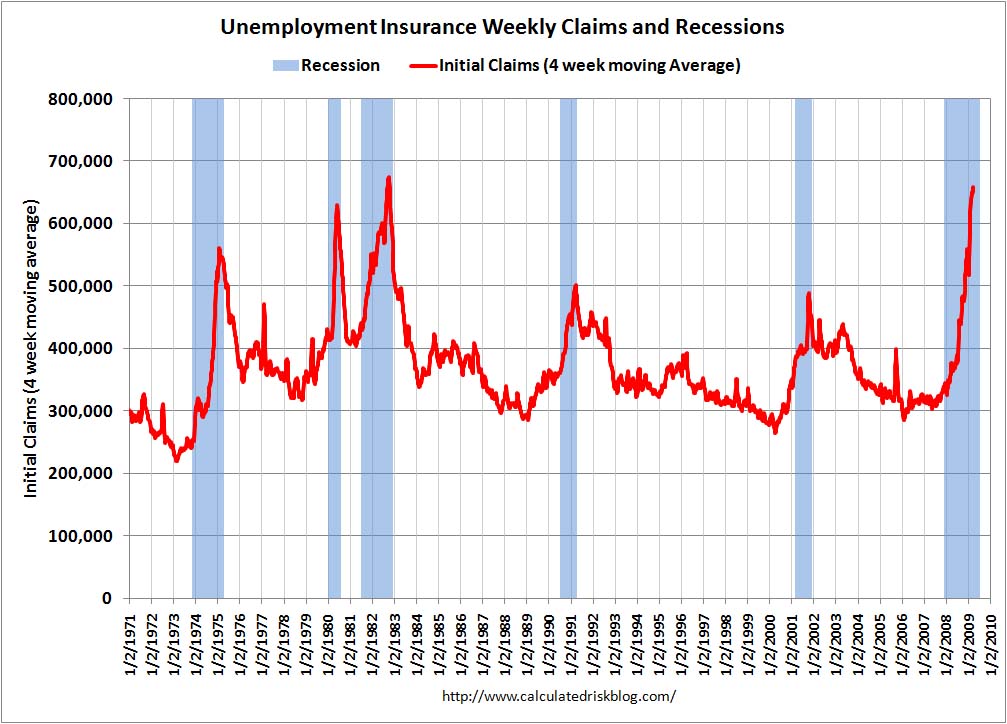


Calculated Risk: End of Recessions and Unemployment Claims

Saturday, December 06, 2008

Time to Buy a House?

"Five or 10 years from now, when the financial crisis has ended and housing prices are up smartly once more, we will look in the rearview mirror and realize that we missed a golden age for first-time home buyers. Then, everyone who sat on their down payment savings accounts for a few years too long will kick themselves for not taking advantage of what may turn out to be the buying opportunity of a lifetime for those who can qualify for a mortgage. Unfortunately, we do not know when this golden age will begin, because we will be able to identify a bottom to the housing market only with the benefit of hindsight. But as it does with the stock market, the moment will probably arrive when everyone is feeling the most pessimistic. That moment is certainly getting closer. Housing prices have fallen drastically from their peak levels in many areas of the country. Rates on 30-year fixed-rate mortgages are already close to 5.5 percent, and this week there were suggestions that the federal government might try to drive them down to 4.5 percent, a truly incredible figure to be able to lock in for three decades." Your Money - It May Be Time to Think About Buying a House - NYTimes.com

Saturday, November 29, 2008

Public School Reform in D.C.

"The U.S. spends more per pupil on elementary and high school education than most developed nations. Yet it is behind most of them in the math and science abilities of its children. Young Americans today are less likely than their parents were to finish high school. This is an issue that is warping the nation's economy and security, and the causes are not as mysterious as they seem. The biggest problem with U.S. public schools is ineffective teaching, according to decades of research. And Washington, which spends more money per pupil than the vast majority of large districts, is the problem writ extreme, a laboratory that failure made." Can She Save Our Schools? - TIME

Sunday, November 23, 2008

Banking Regulator Played Advocate Over Enforcer

This article is worth reading. The closest thing I've seen to a "smoking gun" on the mortgage regulatory side of things.

"In the parade of regulators that missed signals or made decisions they came to regret on the road to the current financial crisis, the Office of Thrift Supervision stands out. OTS is responsible for regulating thrifts, also known as savings and loans, which focus on mortgage lending. As the banks under OTS supervision expanded high-risk lending, the agency failed to rein in their destructive excesses despite clear evidence of mounting problems, according to banking officials and a review of financial documents. Instead, OTS adopted an aggressively deregulatory stance toward the mortgage lenders it regulated. It allowed the reserves the banks held as a buffer against losses to dwindle to a historic low. When the housing market turned downward, the thrifts were left vulnerable. As borrowers defaulted on loans, the companies were unable to replace the money they had expected to collect." Banking Regulator Played Advocate Over Enforcer - washingtonpost.com

Sunday, November 09, 2008

Black Churchgoers Celebrate Obama's Win

" At Hungary Road Baptist Church in a working-class suburb of Richmond, Virginia, the two-hour, 40-minute service was part celebration, part history lesson, led by a pastor who had felt the sting of the Jim Crow South. The Rev. J. Rayfield Vines Jr., pastor of the predominantly African-American congregation, paused briefly as he recalled the indignities he endured but did not bow to growing up Suffolk, in southeastern Virginia. "I was there when you had [to] ride in the back of the bus," Vines said under a simple cross illuminated by eight light bulbs. "I was there when you went to the department store and you couldn't try on the clothes. I was there when they had a colored toilet and a white toilet." The pastor said he shared his humiliations Sunday to help give those "who had not tasted the bitterness of segregation ... an idea why we all shouted." "My cup runneth over on Tuesday night," Vines said. "My eyes have seen the glory." Inside Harlem's Abyssinian Baptist Church, Obama T-shirts vied with colorful plumed hats as a fashion statement. Church member Sheila Chestnut, 61, wore a rhinestone Obama pin on her suit lapel. "I am so happy," she said. "I cried so much. I never thought that in this lifetime I would live to see an African-American become president of these United States." When the Rev. Calvin Butts invited the congregation to stand up "and give God praise for the election," several hundred churchgoers rose as one, lifted their hands in the air and gave a sustained cheer, then chanted, "Yes we can! Yes we can!"" Black churchgoers celebrate, give thanks for Obama's win - CNN.com